Sustainability at the Business School

Professor Steve Wood
Deputy Pro-Vice-Chancellor and Dean of the Business School"The University of Exeter Business School is guided by three strategic pillars: environmental sustainability, responsible leadership, and technological transformation. We believe that it is at the intersection of these priorities that meaningful and lasting change can be achieved. Across all three pillars, we work with regional, national, and global organisations to help them respond to, and prepare for, the wicked challenges of our time. We do this by partnering with businesses and policymakers through impactful research, equipping our students with the principles of sustainable and responsible business as they develop into the leaders of tomorrow, and bringing our expertise directly into organisations and boardrooms through Executive Education."
Governance - School Sustainability Group
Purpose & Scope
The University of Exeter Business School is committed to a truly embedded sustainability culture that runs through everything we do. The School Sustainability Group (SSG) is responsible for coordinating and cohering all aspects of the Business School’s activity with respect to this. The group will measure, report and share updates against the Faculty Sustainability Strategy priorities as implemented by the Business School. It will deliver on the University of Exeter’s corporate sustainability and climate change-related objectives and ‘use the power of our education and research to create a sustainable, healthy and socially just future’ (Strategy 2030).
The scope and responsibilities of the group will include:
- Working to cohere and accentuate consideration of sustainability priorities in all departments and across the four sovereign portfolios (Education, Research, Global and Business Education) - recognising that a focus on sustainability is already established as a core focus within these areas.
- To develop and own a School-level sustainability action plan which encompasses all sovereign strategy areas.
- To provide a forum for the sharing of best practice and expertise.
- To give increased visibility to sustainability-related activity, both internally and externally.
- To support the development of staff and student awareness and commitment to sustainability.
- To engage with Faculty and University-level governance bodies relating to sustainability.
- To contribute where appropriate to School-level accreditation process and submissions.
Membership
| Name | Role |
|---|---|
| Dr Constantine Manolchev | Chair and Management Representative |
| Professor Angela Christidis | Finance and Accounting Representative |
| Dr Ben Balmford | Economics Representative |
| Dr Graham Perkins | Education Strategy Group Representative |
| Professor Bill Peng | Global Strategy Group Representative |
| Rachel Jones | Global Strategy Group Representative |
| Professor Stuart Robinson | Professional Education Group Representative |
| Jonnie Critchley | School Manager |
| Dr Dawn Scott | Professional Services Representative |
| Jorandi Scholtz | Professional Services Representative |
| Matthew Taylor | Accreditation and Rankings Manager |
| Molly Stoker-Diver | Accreditation and Rankings Officer and Secretary |
| Sarah Jerome | Student Representative |
| Liv Philip | Student Representative |
Education
At the University of Exeter, we’re committed to using the power of our education and research to create a greener, healthier, and fairer future for all. These ideas are at the heart of our Strategy2030. Within the Business School what and how we teach, and support learning is integral to achieving the aims of Strategy2030.
SDG mapping
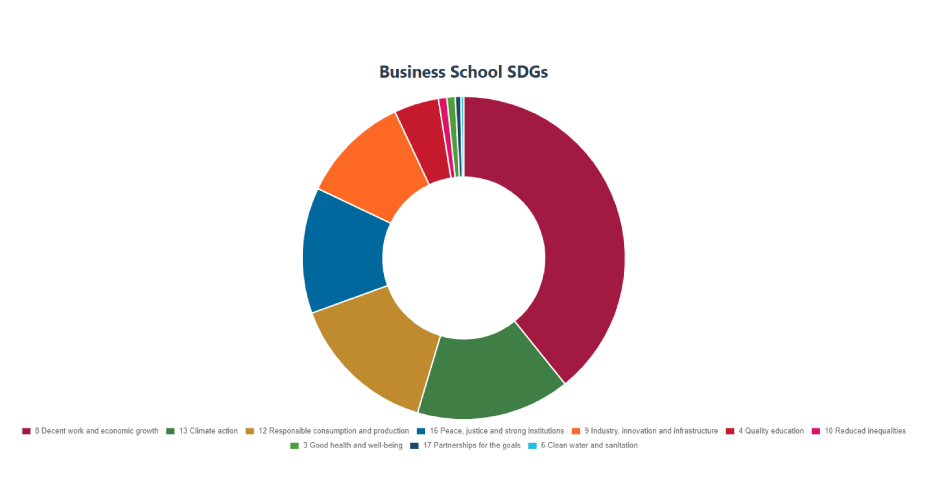
All active modules across the Business School have been mapped against the 17 United Nations’ Sustainable Development Goals (UN SDGs). This mapping was completed in February 2026 using AI-automation in a project led by staff and students.
10 out of the 17 SDGs were represented across 357 modules, with the most common SDGs being:
- SDG 8 - Decent Work (140 modules);
- SDG13 - Climate Action (55 modules);
- SDG12 - Responsible consumption and production (53 modules).
Sector-Wide Social Impact and Sustainability Initiatives
The School is a strong advocate for global and national initiatives that promote the integration of environmental sustainability and societal impact and encourage strong participation from our staff and students. Recent schemes and initiatives include:
University-wide Programmes
In addition to the sustainability knowledge and skills embedded in the curriculum, the University, often supported by the School, run a number of schemes and programmes that further enhance these:
Research, engagement and community
At the University of Exeter Business School, our research, partnerships and community activities play a central role in advancing the UN SDGs. Through multidisciplinary collaboration and industry engagement, we are driving progress in key areas of environmental and social sustainability.
Our work in this field is focussed around the three themes of Environmental Sustainability, Responsible Management and Technological Transformation.
SDG mapping
All peer reviewed journals across the Business School are regularly mapped against the 17 UN SDGs. During the 2022/23 academic year 232 publications touched on at least one SDG (41%). In 2023/24 this number rose to 245 publications (43%). In 2024/25 this number rose again to 267 (43%). In 2024/25 16 out of the 17 SDGs were represented, with the most common SDGs being:
- SDG 8 - Decent Work (94 publications);
- SDG9 - Industry, Innovation and Infrastructure (81 publications);
- SDG11 - Sustainable Cities and Communities (49 publications);
- SDG16 - Peace, Justice and Strong Institutions (49 publications).
Research in focus



Our people
These themes bring together researchers, practitioners and partners to address some of the most significant sustainability challenges facing society and business today.